Version 1.0 · For trained practitioners. Not a self-help resource.
© 2026 Widdows Consulting Ltd
Kabbalah
Jewish esoteric tradition emerging in twelfth- and thirteenth-century Provence and Spain, culminating in the Zohar (c. 1290) and reformulated by Isaac Luria in sixteenth-century Safed. Its central image is the ten sefirot emanating from the infinite (Ein Sof); Lurianic Kabbalah adds the shattering of the vessels and the work of repair (tikkun).
Mediterranean & Middle East · Status: Open (textual) / Living
Coaching Practitioner Manual §2.5, pp. 34–37 · truncated cell editorially completed; citations unverified. Correspondences are exploratory, not validated.
Overview
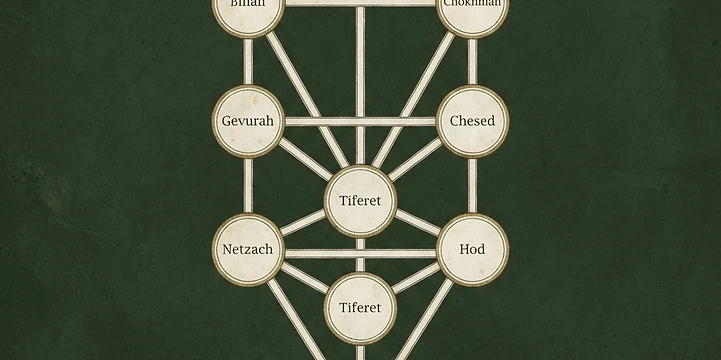
Kabbalah belongs within Jewish mystical life, not a free-floating symbolic system. The source introduces Ein Sof (the infinite), the ten sefirot (emanations), shevirat ha-kelim (shattering of vessels), tikkun (repair), and Hebrew letters. It describes roots in early Jewish mysticism and development in medieval Spain and Provence. Coaches should not teach sacred names, ritual or the Tree of Life without training and context. The PDF cuts off its Integration coaching cell; the prior editorial brief supplied its completion.
Coaching relevance
| Dimension | Source perspective | Coaching framing |
|---|---|---|
| Presence | A spark of divine light | Symbolic attention in the client’s own context |
| Identity | Soul related to the infinite | Explore identity without universalising Jewish views |
| Narrative | Brokenness and repair | Do not treat trauma as spiritually necessary |
| Regulation | Sefirot such as mercy and judgement | Reflect on boundaries without teaching ritual |
| Integration | Tikkun restores harmony | Provides a spiritual model of repair, wholeness and responsibility (editorial completion) |
Territory correspondences
| Territory | Exploratory source correspondence |
|---|---|
| 1 · Consensus Reality | Ordinary attachment associated with Malkhut (Scholem, 1996). |
| 2 · Personal Narrative | Shevirat ha-kelim as source analogy for rupture (Kaplan, 1990); not a trauma diagnosis. |
| 3 · Adjusted Cognition | Teshuvah, Torah and mitzvot in Jewish practice (Idel, 1990). |
| 4 · Imaginal / Transcendent Visualisation | Sefirot, letters and merkavah imagery in specialist context (Idel, 1990). |
| 5 · Oneness / Union with Source | Devequt, cleaving to the Divine (Scholem, 1996). |
| 6 · Ego Death / Dissolution | Ayin and surrender of personal will (Idel, 1990). |
| 7 · Integration / Return | Tikkun through compassion, justice and service (Kaplan, 1990). |
Practice reflection
Tree of Inner Balance · 15–20 minutes
The source proposes reflecting on Chesed (lovingkindness), Gevurah (strength/boundary), and Tiferet (harmony/beauty). Its full Tree of Life is a Jewish religious map; a secular alternative is discussing care, boundaries and balance in the person’s own language.
Further reading
Source anchors (p. 36): Scholem, Major Trends in Jewish Mysticism (1996); Kaplan, Sefer Yetzirah (1990); Idel, Kabbalah: New Perspectives (1990).
Further reading (p. 37): Daniel C. Matt, The Essential Kabbalah and Zohar translation; Aryeh Kaplan, Meditation and Kabbalah; Adin Steinsaltz, The Thirteen Petalled Rose; Rabbi David Cooper, God is a Verb.
Anchors (APA 7)
Scholem (1941), Major Trends in Jewish Mysticism; Idel (1988), Kabbalah: New Perspectives.