Version 1.0 · For trained practitioners. Not a self-help resource.
© 2026 Widdows Consulting Ltd
The Western Magickal Tradition
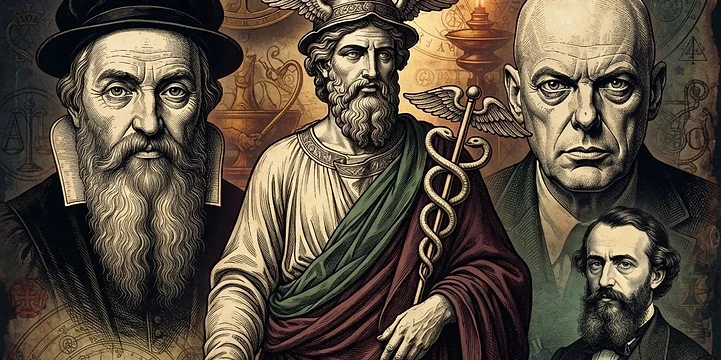
Modern ceremonial magic from the Hermetic Order of the Golden Dawn (1888) through Crowley's Thelema (1904) to chaos magick (1970s): a synthesis of Kabbalah, Hermeticism, tarot and astrology into graded initiatory systems oriented to the discovery of the "True Will". Academic study of the field is recent and treats it as a product of late-Victorian and modernist culture.
Europe · Status: Open
Coaching Practitioner Manual §2.9, pp. 50–53 · editorial territory-order reconciliation; citations unverified. Correspondences are exploratory, not validated.
Overview
The source describes a diverse field of Renaissance and later ceremonial symbolism, drawing on Hermeticism, alchemy, astrology and adaptations of Kabbalah. It names the Golden Dawn, Thelema and Chaos Magick, and themes of True Will, initiation, tarot, symbolic ritual and the relation of will to identity. These systems differ; their ritual and sacred names are not generic coaching tools. Examine symbolism as a client-reported experience without asserting that supernatural forces are present.
Coaching relevance
| Dimension | Source perspective | Coaching framing |
|---|---|---|
| Presence | Ritual as focused attention | Reflect on gesture, space and language |
| Identity | Mythic and multidimensional self-image | Explore narrative without imposing a sacred identity |
| Narrative | Symbols as interpretive patterns | Use metaphor with client consent |
| Regulation | Rhythm and repetition | Notice personally meaningful anchors |
| Integration | True Will as alignment | Explore values and responsible action |
Territory correspondences
| Territory | Exploratory source correspondence |
|---|---|
| 1 · Consensus Reality | Ordinary life described as bound by convention (Crowley, 1997). |
| 2 · Personal Narrative | Shadow and complexes in dream and symbol work (Jung, 1968). |
| 3 · Adjusted Cognition | Reports of omens and synchronicity in an esoteric frame; not proof of external forces (Fortune, 2000). |
| 4 · Imaginal / Transcendent Visualisation | The source discusses pathworking, invocation and evocation (Regardie, 1989); outside ordinary coaching scope. |
| 5 · Oneness / Union with Source | Holy Guardian Angel and True Will in Thelemic teaching (Crowley, 1997). |
| 6 · Ego Death / Dissolution | “Crossing the Abyss” as an esoteric initiatory claim (Regardie, 1989); not a coaching intervention. |
| 7 · Integration / Return | Embodiment of chosen commitments in daily life (Fortune, 2000; Crowley, 1997). |
Practice reflection
Name Your Will · 15–30 minutes
The source asks the person to imagine their highest expression, name its quality and optionally draw a glyph or symbol. Use this as values-oriented reflection if wanted, not as ceremonial initiation, spiritual authority or an assessment of “True Will”.
Further reading
Source anchors (p. 52): Crowley, Magick: Liber ABA (1997); Fortune, The Mystical Qabalah (2000); Jung, Psychology and Alchemy (1968); Regardie, The Golden Dawn (1989).
Further reading (p. 53): Crowley, The Book of the Law; Donald Michael Kraig, Modern Magick; William Whitecloud, The Magician’s Way; Israel Regardie, The Golden Dawn; Phil Hine, Condensed Chaos; Alejandro Jodorowsky, Psychomagic; Angeles Arrien, The Tarot Handbook.
Anchors (APA 7)
Owen (2004), The Place of Enchantment; Hanegraaff (Ed.) (2006), Dictionary of Gnosis and Western Esotericism.