Version 1.0 · For trained practitioners. Not a self-help resource.
© 2026 Widdows Consulting Ltd
Gnosticism
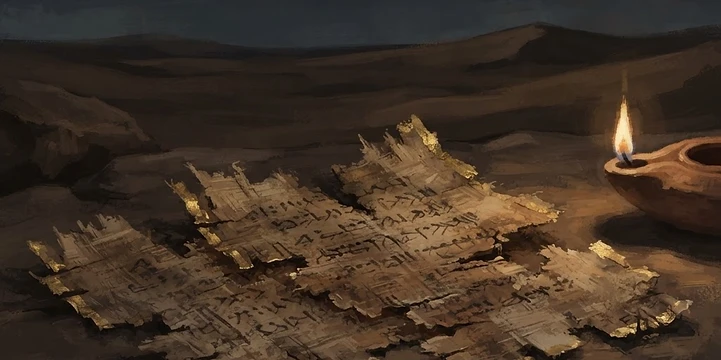
A cluster of second- and third-century movements, mostly Christian, known chiefly through the Nag Hammadi library (found 1945), sharing the themes of a divine spark, a flawed creator, and salvation through knowledge (gnōsis). Scholars including Williams and King argue "Gnosticism" is a modern category imposed on diverse groups; the page uses it with that caveat.
Mediterranean & Middle East · Status: Open (textual)
Draft — pending editor review · added beyond the first .pdf edition; correspondences exploratory. Correspondences are exploratory, not validated.
I · Overview & core concepts
“Gnosticism” names a family of late-antique currents, urban and literate, whose shared thread is gnōsis: knowledge by direct acquaintance rather than belief. Characteristic motifs: the divine spark resident in the human person; the Demiurge — an ignorant maker-god — and his archons, the powers that govern the constrained world; Sophia, whose fall begins the drama; and the Pleroma, the fullness of the divine. The Nag Hammadi library (Meyer, 2007) gives direct access to texts such as the Gospel of Thomas; Pagels (1979) remains the classic historical entry; Jonas (1958) reads the myth existential-ly, as a portrait of the self fallen into forgetfulness; DeConick (2016) traces the continuing life of Gnostic themes in modern spirituality.
Two framing cautions for coaching: first, the mythic language describes inner experience and is not a cosmology to be believed; second, the tradition’s world-rejecting edge requires careful handling (see Cautions).
II · Coaching relevance
| Dimension | Source perspective | Secular framing |
|---|---|---|
| Presence | Wakefulness against sleep and forgetfulness | Returning attention from autopilot to direct experience |
| Identity | The divine spark beneath conditioning | A felt sense of self deeper than roles and stories |
| Narrative | Fall, exile and return as mythic arc | Honouring alienation without amplifying it |
| Regulation | Symbolic engagement with “powers” that bind | Distinguishing inner pattern from feared hidden control |
| Integration | Living in the world without belonging to it | Meaning and discernment inside ordinary life |
III · Transpersonal Diagnostics mapping
| Territory | Exploratory source correspondence |
|---|---|
| 1 · Consensus Reality | Sleep and forgetfulness: life “under the archons”, lived on the terms of the given world. |
| 2 · Personal Narrative | The call: a stirring of the spark — an unaccountable sense that there is more to be known. |
| 3 · Adjusted Cognition | Recognition of alienation; Sophia’s fall as shadow narrative — exile examined as one’s own story, not only a doctrine. |
| 4 · Imaginal / Transcendent Visualisation | Visionary ascents and symbolic sayings (Gospel of Thomas); encounters with aeons as the imaginal opens. |
| 5 · Oneness / Union with Source | Return to the Pleroma; the bridal chamber — reunion imagined as restoration of wholeness. |
| 6 · Ego Death / Dissolution | Dissolution of the counterfeit self; the constructed identity seen through. |
| 7 · Integration / Return | The pneumatic living in the world without belonging to it — an integration symbolised by service rather than withdrawal. |
Cautions & referral
Gnostic dualism can feed world-rejection and persecutory framings — “the system is controlled by hidden powers”. Differentiate archetypal from literal readings with clients: the archons read as inner compulsions and social conditioning; literal belief in hidden controllers, especially with distress or conviction, is a referral flag.
IV · Practice activity
The Call · 10 minutes
Recall a moment when routine broke — an unexpected beauty, a line of text, a loss that woke you. What called? What was heard, and what was ignored or explained away? Let the memory be retold in three sentences, then ask what — if anything — it is asking of you now. Reflective and secular; this is not clinical care.
V · Further reading
Pagels, E. (1979). The Gnostic gospels. Random House.
Jonas, H. (1958). The Gnostic religion. Beacon Press.
Meyer, M. (Ed.). (2007). The Nag Hammadi scriptures. HarperOne.
DeConick, A. (2016). The Gnostic new age. Columbia University Press.
Anchors (APA 7)
King (2003), What Is Gnosticism?; Meyer (2007), The Nag Hammadi Scriptures.